
A Psych NP’s Guide to Why You Think You Have ADHD
… And What Else It Could Be
Part Two of My ADHD Deep Dive
You’re here because your brain feels like a browser with 78 open tabs, four of which are playing music, and you're wondering, "Is this the infamous Adult ADHD?"
It’s a fair question! The symptoms—inattention, restlessness, the feeling that you’re living life in fast-forward—are incredibly common. But here’s the thing: ADHD is the celebrity of "Can't Focus" disorders. Everyone knows the name. However, your symptoms could be caused by a whole chorus of other, less famous, but equally dramatic, conditions.
Let’s review the "ADHD Imposters" list. Think of it as a psychiatric lineup.
The Great Imposters: What Else Is Hijacking Your Focus?
Act 1: The Brain’s Quirky Roommates (Neurodevelopmental)
Autism Spectrum Disorder (ASD): The Detail Enthusiast.
The Mix-Up: Trouble organizing or managing social chit-chat can look like inattention.
The Tell: With ASD, you might have trouble not focusing on your deep, restricted interest (like, the history of 17th-century doorknobs). ADHD distraction is like, "Ooh, a butterfly!" ASD distraction is like, "Please stop talking about the butterfly, I’m trying to calculate the tensile strength of this paperclip."
Learning Disorders: The Silent Saboteur.
The Mix-Up: If reading or writing takes 8,000% more effort than it should, you’ll look like you have poor follow-through.
The Tell: It’s not that you're uninterested in the report; it's that your brain is staging a small, internal coup every time it encounters the word "synergy."
Act 2: The Emotional Rollercoasters (Psychiatric Conditions)
Anxiety Disorders: The Worry Worm.
The Mix-Up: You feel restless, jumpy, and can’t concentrate.
The Tell: In ADHD, you’re distracted because your brain wants novelty. In anxiety, you’re distracted because your brain is trying to draft an 800-page worst-case scenario novel about your upcoming dentist appointment. You’re not seeking stimulation; you’re being relentlessly pestered by your own catastrophic thoughts.
Depression: The Energy Vampire.
The Mix-Up: Low energy, poor focus, and no motivation.
The Tell: If you have ADHD, you want to do the thing, you just physically can’t organize the steps. If you’re depressed, you're looking at the thing and thinking, "I don't have the emotional bandwidth to care if that thing is done, or if gravity still works."
Bipolar Disorder: The Mood Swingers.
The Mix-Up: During a high phase, you're impulsive, have racing thoughts, and might suddenly decide to buy a parrot sanctuary. Very ADHD-esque.
The Tell: The key is the episodic nature (meaning it comes and goes within distinct periods of time). Your symptoms aren't constant; they arrive with a bang, driven by a powerful mood state (mania/hypomania), and then retreat, unlike the constant background static of ADHD.
PTSD: The Eternal Sentinel.
The Mix-Up: Feeling constantly "on edge," easily startled, and having trouble focusing because you’re hyper-vigilant.
The Tell: If your symptoms are tied to past trauma and you occasionally have a flashback that makes you feel like you just stepped on a landmine, we're likely in the PTSD territory. ADHD doesn’t generally involve nightmares about your fifth-grade math teacher.
Substance Use Disorders: The Fog Machine.
The Mix-Up: Using alcohol, cannabis, or other substances can mess with your focus, mood, and impulse control.
The Tell: If your attention issues only started after you began substituting coffee with energy drinks and tequila, we have a clear starting point to address.
Act 3: The Body’s Bad Habits (Medical & Lifestyle)
Sleep Disorders (Sleep Apnea, Insomnia, etc.): The Zombie State.
The Mix-Up: Daytime fatigue, brain fog, and irritability that destroys focus.
The Tell: If you're only getting four hours of quality sleep, your brain is functioning on fumes. No amount of stimulant medication can fix a chronic sleep deficit. If you snore like a hibernating bear, let’s talk sleep studies and CPAP before we talk Ritalin.
Thyroid Troubles: The Internal Thermostat is Broken.
The Mix-Up: Being overactive (hyperthyroid) can make you restless; being underactive (hypothyroid) can make you sluggish and foggy.
The Tell: This is why we do blood work! We need to make sure your thyroid isn't secretly sabotaging your entire life.
Environmental Factors (Stress, Burnout, Mismatch): The Overloaded Server.
The Mix-Up: Ongoing stress, a terrible job, or feeling perpetually overwhelmed.
The Tell: Your brain is not diseased; it's just waving a tiny white flag because your life is structured in a way that is utterly exhausting.
Honorable Mentions: The Deep-Cut Distractors
There’s a whole B-side album of conditions that can sneakily mimic ADHD. We always keep an eye out for these rare but significant possibilities: Personality Disorders (which can drive impulsivity and chaotic relationships), Intermittent Explosive Disorder (if the main issue is sudden, disproportionate rage, not just minor frustration), other Learning Disorders beyond the basics (like non-verbal learning disorder), and even environmental toxins like Lead Poisoning (yes, seriously—always check your old paint and plumbing!). We screen for the major players first, but we don't forget these understudies.
The Clinician's Detective Kit: How We Get to the Real Truth
Since your focus issues could be anything from ADHD to simply needing a new job, we can’t just rely on a gut feeling. We need evidence! This is the process we use to separate the true ADHD from the clever imposters
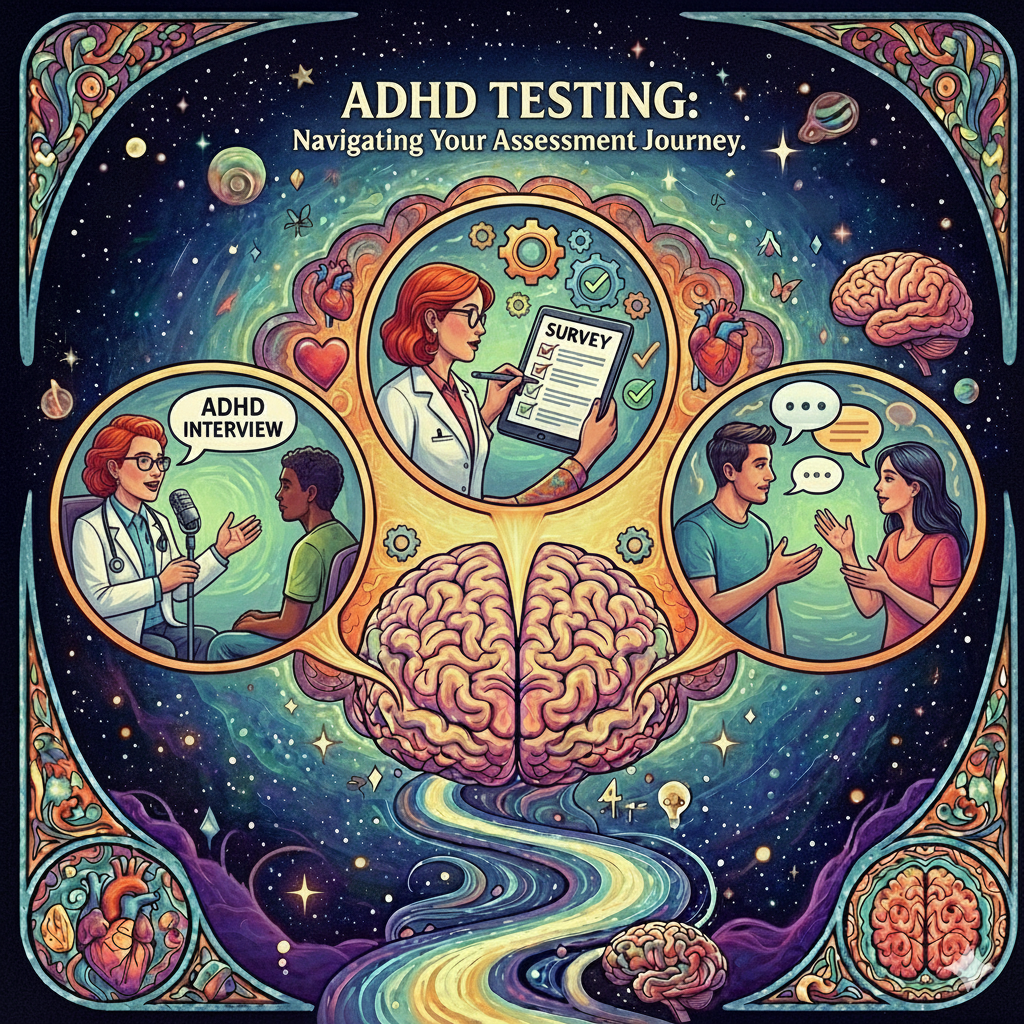
The Deep Dive (The Clinical Interview)
This is where you and I spend some quality time. I’ll ask about your entire life history—from your report cards to your relationships—and we'll see if your symptoms fit the ADHD timeline (starting before age 12) and severity criteria (causing issues in at least two settings).
The Homework (Self-Report Questionnaires)
You get homework! These standardized rating scales aren't a definitive diagnosis, but they're excellent tools for pointing us in the right direction. They help us systematically quantify how bad your inattention and hyperactivity/impulsivity are compared to other adults.
The Corroboration (Family & Friends Input)
Sometimes, how you think you act and how you actually act are two separate, hilarious, and sometimes frustrating stories. If you consent, I may ask to speak to a close family member, partner, or friend. These "second-hand reports" help us verify:
The Childhood History: Did your third-grade teacher write that you talked too much or stared out the window?
The Current Impact: Does your partner confirm that you lose your keys 17 times a week?
The Physical Checkup (Labs and Medical Records)
Before we start treating your brain, we need to make sure your body isn't pulling a fast one. We will:
Order Blood Labs: We need to check for things like thyroid issues or vitamin deficiencies (like Vitamin D or B12) that can cause severe fatigue, mood swings, and brain fog.
Review Your Medical History: We'll ask your Primary Care Doctor (PCP) to send us your relevant medical records. We look for conditions like chronic sleep disorders, history of concussions, or certain medications that might be affecting your focus. This is a critical step in excluding the medical imposters.
The Bottom Line: Getting the diagnosis right is absolutely crucial. Treating an anxiety disorder with ADHD medication, or trying to manage ADHD without treating underlying sleep apnea, is like using a butter knife to fix a broken engine—it’s just going to be a messy, frustrating disaster.
So, relax (as much as you can manage), tell me everything, and let’s figure out why your brain is currently throwing a party that no one was invited to.
Articles & Sources for More Information
Faraone, S. V., Asherson, P., Banaschewski, T., Biederman, J., Buitelaar, J. K., Ramos-Quiroga, J. A., Rohde, L. A., Sonuga-Barke, E. J. S., Tannock, R., & Franke, B. (2021). Attention-deficit/hyperactivity disorder. World Psychiatry, 20(2), 96–123. https://doi.org/10.1002/wps.21374
