
Beyond the Cycle: How Suboxone Supports Recovery from Opioid Use Disorder
If you or someone you love is navigating the complexities of opioid use—whether it began with a prescription for chronic pain or involves substances like heroin or fentanyl—you know how heavy the burden can feel. The constant cycle of withdrawal and cravings can make a "normal" life feel out of reach.
To help my patients understand why they feel the way they do, I find it’s helpful to look at what is happening at the cellular level. Opioid Use Disorder isn't just a habit; it is a physical recalibration of the brain's chemistry.
At my practice, I view Opioid Use Disorder (OUD) not as a failure of willpower, but as a manageable chronic medical condition. Suboxone is one of the most effective tools I use to help my patients regain their footing and focus on the lives they want to lead.
The Science: How Suboxone Stabilizes the Brain
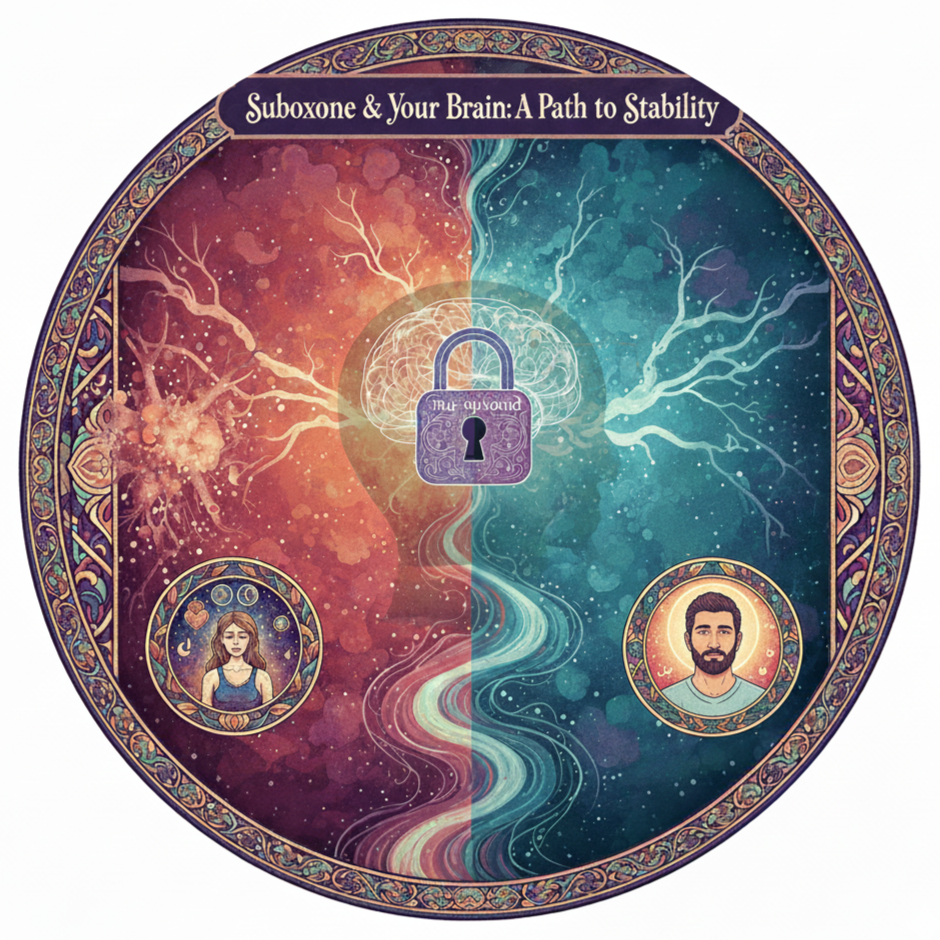
To understand how Suboxone helps, we have to look at the mu-opioid receptors in your brain. Think of these receptors like "locks" that control the release of dopamine—the chemical responsible for reward and pain relief.
When someone uses a "full agonist" opioid (like oxycodone, heroin, or fentanyl), it swings those locks wide open, causing a massive flood of dopamine. Over time, the brain becomes overwhelmed and tries to protect itself by "turning off" its own natural feel-good chemistry. This is why, without the drug, a person feels physically ill and emotionally "gray"—this is the biological root of a craving.
Suboxone works differently because of its primary ingredient, Buprenorphine:
The "Sticky" Shield (High Affinity): Buprenorphine has a very high "affinity" for those opioid receptors. It essentially "sticks" to the lock more tightly than other opioids. This means it can actually knock other opioids off the receptor and block them from getting back on, which significantly lowers the risk of overdose if a relapse occurs
The "Gentle" Key (Partial Agonism): Unlike fentanyl, which swings the lock all the way open, buprenorphine is a partial agonist. It opens the lock just enough to satisfy the brain’s physical need and stop withdrawal, but not enough to cause a "high" or significant respiratory depression
Ending the "Rollercoaster": Because it has a very long half-life, the medication stays on the receptor for a long time (24–72 hours). This levels out the brain chemistry, stopping the exhausting "peaks and valleys" of use and withdrawal, allowing your brain’s natural chemistry to begin the slow process of healing.
Supporting You at Any Stage
I believe that the transition into treatment should be as seamless and stress-free as possible. Whether you are just beginning to consider change or are transitioning from a higher level of care, I am here to partner with you:
Starting Treatment (Induction): If you are currently using opioids and are ready to stop, I am happy to help you safely start Suboxone. I will guide you through the induction process with a focus on your comfort and safety. Additional medications can be prescribed to assist with any withdrawal symptoms you may experience along the way.
Continuing Your Progress: If you are being discharged from a residential program, detox, or a structured program (PHP/IOP), or if you are seeking a new prescriber, I can take over your Suboxone management. My goal is to provide the continuity of care that is so essential for long-term stability.
Addressing the Intersection of Pain and Opioids
Many of my patients never intended to struggle with opioids; they were simply seeking relief from chronic pain. Over time, traditional opioids can actually make pain feel more intense—a phenomenon called hyperalgesia.
Suboxone offers a unique path forward for those with dual needs:
Suboxone offers a unique path forward for those with dual needs:
Breaking the Cycle: It stops the need for escalating doses, allowing us to focus on a more sustainable, long-term pain strategy.
Safer Relief: Buprenorphine provides effective pain management with a much lower risk of respiratory problems than traditional opioids.
Safer Relief: Buprenorphine provides effective pain management with a much lower risk of respiratory problems than traditional opioids.
Breaking the Cycle: It stops the need for escalating doses, allowing us to focus on a more sustainable, long-term pain strategy.
Do You Have to Stay on Suboxone Forever?
The short answer is: Only as long as it is serving your health and stability.
Recovery is about building "recovery capital"—resilience in your mental health, and stability in relationships and daily environment. For some, staying on Suboxone long-term provides a vital safety net. For others, a very slow, medically supervised taper is the ultimate goal.
There is no "right" timeline, and I believe there is no prize for suffering. We will decide together what your path looks like, and I will adjust your treatment based on your unique life stressors and goals.
A Collaborative Approach to Recovery
Medication is a powerful foundation, but I believe recovery is strongest when it is holistic. In my practice, I emphasize:
Individualized Tapers: If and when you are ready to reduce your dose, we do it at your pace—over months or even years—to ensure your brain and body stay in balance.
Total Support: I look at the whole person, integrating attention to sleep, mood, and stress management into your care.
Harm Reduction: I recognize that recovery from addiction is not a linear path - it’s more of zig-zag or a wave with ups and downs; you won’t be penalized or judged for having setbacks. Relapse is often a part of the journey.
Your Path, Your Way
Recovery is not about perfection; it is about finding a way to live with dignity. Whether you are looking to start treatment for the first time or need a supportive provider to continue your care after a structured program, I am here to support you.
